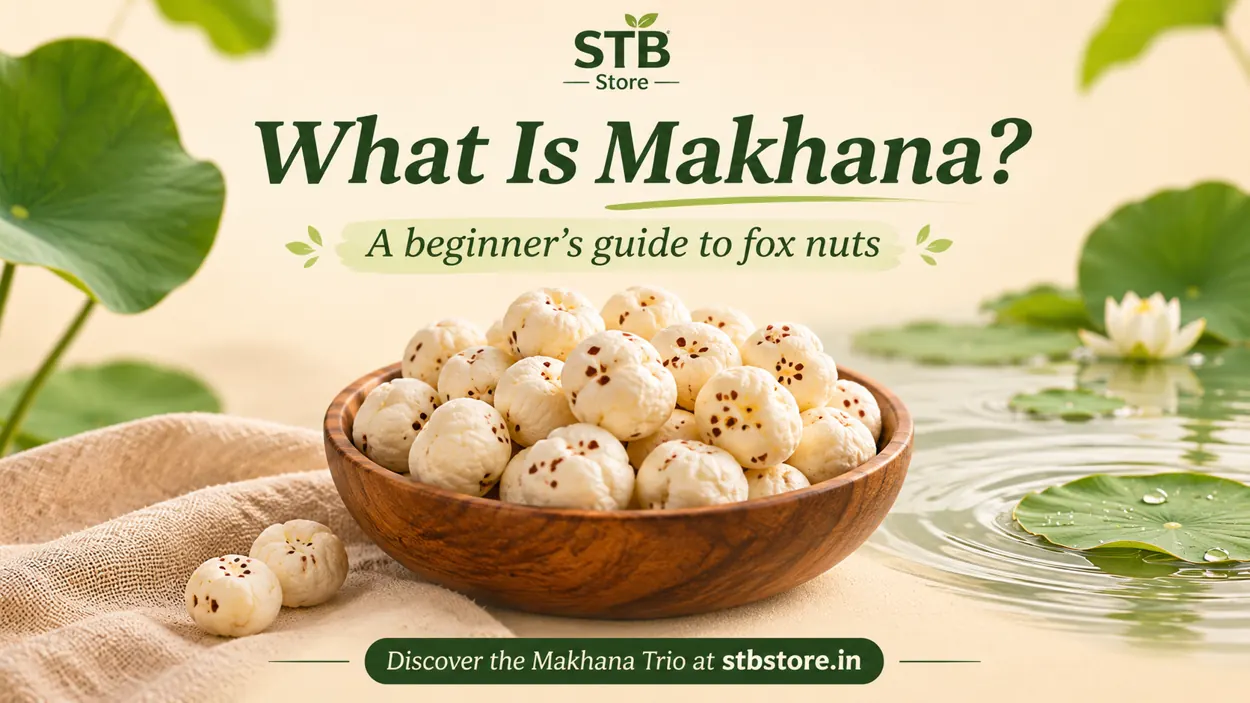
A bowl of makhana looks simple: little white puffs, light and crunchy, ready for chai time. But those puffs begin life in an unexpected place—underwater. Before a single seed becomes a snack, it passes through cultivation, patient harvesting, careful drying and a demanding popping process.
In this guide, we follow the journey of makhana from pond to pack, explain why Bihar is so important to the crop, and show what to look for when choosing makhana for your kitchen.
1. Makhana begins as an aquatic plant
Makhana is the popped seed of Euryale ferox, an aquatic plant sometimes called the gorgon nut plant. Its large floating leaves spread across ponds and wetlands. The plant develops fruits containing hard seeds, which eventually settle in the water. Despite the familiar name “fox nuts,” the crunchy snack is not a tree-grown nut.
The crop is well suited to water-rich environments. Traditional pond cultivation remains important, although growers also raise makhana in managed, shallow, waterlogged field systems. In both approaches, water is central to the plant’s growth.
2. Why Bihar is at the heart of the story
North Bihar—especially the Mithila region—has a long relationship with makhana cultivation and processing. Its ponds, agricultural knowledge and skilled workers have helped turn the seed into a valued food. Makhana is also cultivated elsewhere in eastern and northeastern India, but Bihar remains a major centre of production.
This is not just a story about a crop. It is also about the livelihoods of growers, harvesters, roasters and traders. Traditional knowledge, including harvesting submerged seeds and popping them by hand, has been passed between generations. Research organisations and public programmes are working on improved varieties, safer methods and mechanisation.
3. How farmers grow makhana
Farmers prepare a suitable water body or managed field, establish the crop, and maintain conditions that allow the aquatic plants to develop. The growing leaves spread across the water surface while seed-bearing structures develop over the season. The exact calendar varies with location, cultivation system and weather.
Unlike harvesting a cereal field, collecting makhana involves the underwater environment. As mature seeds fall and settle, harvesting becomes a job that requires expertise and considerable physical effort. In traditional pond systems, experienced workers gather seeds from the bottom rather than simply picking dry pods from a plant above ground.
4. Harvesting seeds from the pond
In traditional methods, makhana seeds that have settled on the pond bed are located, gathered and brought out of the water. Workers use practiced techniques and locally adapted tools. Because seeds can be spread across the pond bottom, the work demands patience, skill and repeated effort.
After collection, the seeds are washed to remove mud and other unwanted material. This stage is very different from the white puffs you see at home: the harvested seeds have a hard outer covering. They must be prepared correctly before they can pop.
5. Cleaning, drying and grading the seeds
Harvested seeds are cleaned, dried and sorted or graded, often by size. Grading is important because seeds of different sizes do not necessarily respond to heat in exactly the same way. A more uniform batch helps workers manage roasting and popping.
Drying also matters. The raw seed has a different moisture profile from the final snack. Careful preparation helps make the next stages more consistent. Processing methods vary between traditional workshops and mechanised facilities, so no single method describes every producer.
6. How hard seeds become white, crunchy makhana
The most fascinating step is popping. The prepared seeds are heated, and their hard outer shells must be opened at the right moment. In traditional processing, skilled workers heat batches and use a rapid manual striking or malleting action to release the expanded white interior. Timing is critical: too much heat, too little heat or a delay in handling can reduce the quality of the popped product.
The result is the familiar light, porous puff. Modern food-processing research has developed machines for washing, grading, roasting and popping, with the aim of improving efficiency and reducing difficult manual work. Whether traditional or mechanised, popping is a specialised process—not the same as casually roasting already-popped makhana at home.
7. Why packing matters
After popping, makhana is sorted and packed for distribution. The airy texture that makes it pleasant to eat also means it can lose crispness if exposed to moisture. That is why appropriate packaging and dry storage matter.
When buying, check that the package is intact, read the ingredient and allergen declaration, confirm the net weight, and follow the pack’s storage and best-before instructions. Plain makhana and flavoured makhana are not identical products: added oils, seasonings and other ingredients can change the nutrition profile and allergen information.
8. From the pack to your kitchen
Once you have plain popped makhana, an easy way to enjoy it is to dry-roast it gently in a pan, stirring until crisp. Add spices after or near the end of heating, depending on the recipe. Some people use a little ghee or oil; others prefer a simpler dry-roasted version. Let it cool before storing in a clean, airtight container.
Makhana also appears in sweet dishes such as kheer, while flavoured versions can be eaten straight from the pack. These uses show why one humble aquatic seed can fit into several different snack occasions.
Discover the ₹499 Makhana Trio
Plain 100 g · Roasted 90 g · Makhana & millet cookies 100 g. Delivery included for serviceable PIN codes.

Promotional illustration only. Actual supplier packaging differs.
9. What should buyers look for?
Start with purpose. Choose plain makhana if you want to roast and season it yourself or use it in cooking. Choose ready-to-eat roasted makhana if convenience matters. For a different texture, makhana-based cookies can be a separate accompaniment to tea.
Compare pack sizes rather than only looking at the headline price, and check ingredients carefully if you avoid milk, wheat, peanuts or other allergens. Make sure the seller clearly explains delivery availability, payment terms and customer support. Good product information is just as useful as attractive photography.
Share 10 qualifying orders. Earn a FREE ₹499 combo.
Join free with your email. Share your unique link. Earn a free Makhana Trio for every 10 qualifying orders. Terms apply.

Only qualifying paid orders count. Reward is a product, not cash. See program terms.
From pond to snack bowl
Growing makhana involves far more than scattering seeds and waiting for a harvest. The journey combines water-based agriculture, skilled underwater collection, careful cleaning, grading, controlled heating and the precise work of popping. The next time you enjoy a handful of makhana, you’ll know something about the people and processes behind every crunchy puff.
Interested in trying more than one style? STB Store brings plain makhana, flavoured roasted makhana and makhana & millet cookies together in one combo, with the current product and delivery terms available on the store page.
Frequently asked questions
Does makhana grow on trees?
No. Makhana comes from the seeds of the aquatic plant Euryale ferox, which grows in ponds, wetlands and managed waterlogged fields.
Why is Bihar famous for makhana?
North Bihar has a strong history of makhana cultivation and processing, with specialised agricultural knowledge and a large production ecosystem.
Can I pop raw makhana seeds at home?
Commercial makhana popping requires careful seed preparation, heat and specialised handling. For home snacking, buy already-popped makhana and roast it gently for crispness.
Is makhana the same as lotus seeds?
Makhana is produced from Euryale ferox, which is distinct from the true lotus plant Nelumbo nucifera. The names are sometimes used loosely, so scientific names help avoid confusion.
How can I buy the STB Store Makhana Trio?
Visit stbstore.in to choose the roasted flavour, check PIN-code serviceability and review current checkout information. The listed combo includes 100 g plain makhana, 90 g roasted makhana and 100 g makhana & millet cookies.
Sources and further reading
- ICAR — Mechanizing Makhana Popping
- APEDA — Makhana industry report
- Indian Journal of Extension Education — Traditional wisdom of the Mallah community
- ICAR — National Research Centre for Makhana
Sources explain general cultivation and processing. Product pack information and current sales terms should be checked on the live store page.