STB Store • Makhana Stories • Day 3 • 21 November 2026
Why Is Bihar Famous for Makhana? The Story of Mithila’s Remarkable Water-Grown Snack
Have you ever wondered why Bihar appears so often in conversations about makhana? The answer begins not in a snack factory but in the ponds and wetlands of eastern India, where growers have developed knowledge of a remarkable aquatic crop over generations.
Original photo suggested
Custom editorial illustration; not documentary farm photography.
From Mithila’s ponds to snack bowls across India
Use a licensed or original wide photograph of a makhana-growing pond in Bihar, with accurate location and photographer credit. Do not use an AI image as documentary evidence.
1. First, what actually grows in Bihar?
Makhana is made from the seeds of Euryale ferox, an aquatic plant also called fox nut or gorgon nut. Unlike peanuts or almonds, its seeds are associated with a plant that grows in water. The crop can be cultivated in ponds and other still-water environments, and researchers have also developed field-based methods using controlled shallow water. This distinctive growing environment is one reason makhana has a story unlike most everyday snacks.
When people buy the familiar white, airy makhana, they are seeing a processed, popped seed—not the seed as it appears at harvest. Turning the hard seed into an edible puff requires several steps and considerable skill. That transformation helps explain why the crop supports work beyond cultivation alone.
2. Why Bihar, and why Mithila?
Bihar has long been a major centre of Indian makhana cultivation, especially in its northern districts. ICAR has identified Darbhanga, Madhubani, Purnea, Katihar and other districts as important production areas. Wetland environments, farming knowledge and established processing networks have all contributed to the region’s role.
Mithila is more than a location on a map. It is a cultural region with a strong connection to ponds, fish and makhana. For families who have grown, processed or cooked it for generations, makhana is both a food and part of a local economy. It appears in savoury preparations, milk-based dishes and traditional occasions. That cultural connection is worth understanding before treating makhana simply as a fashionable packaged snack.
Not every pack sold in India necessarily comes from Mithila, however. Bihar’s importance should not be used as proof of origin for a particular product unless its supply chain has been verified.
3. What does the Mithila Makhana GI tag mean?
One milestone arrived in August 2022, when Mithila Makhana received a Geographical Indication (GI) registration. APEDA’s official Bihar GI listing records certificate number 421, dated 16 August 2022, with Bihar as the geographical area. A GI identifies a product whose reputation or characteristics are associated with a particular place and is governed by rules about authorised use.
That does not mean every packet of makhana is automatically GI-tagged. Nor does a GI designation, by itself, establish that a product is organic, more nutritious or superior to every other makhana. Consumers should look for reliable product-origin and certification information instead of assuming these qualities from a general advertisement.
The journey begins with the aquatic plant producing seeds. Farmers collect mature seeds using methods suited to their cultivation system. After collection, seeds are cleaned and dried, then sorted or graded. Heat treatment and popping convert the hard seeds into the expanded white pieces people recognise. The precise equipment and sequence can vary between traditional and mechanised operations.
This is an important distinction: the puff is the result of processing, not a soft fruit picked directly from a pond. Popping performance, grading and careful handling affect the final product. Researchers at ICAR have studied improved varieties and post-harvest practices to help growers and processors improve outcomes.
Next come seasoning, packing and distribution. Plain makhana can be used in many home recipes, while ready-to-eat roasted varieties offer convenience. Ingredients, added oils, flavourings and allergens vary by product, so the actual package label matters more than general claims about makhana.
Makhana farming is not frozen in the past. ICAR reported the release of the Swarna Vaidehi variety in 2013 and described a shallow-water field cultivation method. A 2024 article in the ICAR journal Indian Farming discussed improved varieties, cultivation practices, harvesting and post-harvest management. Such research aims to make production more consistent and economically useful for growers.
These developments matter because makhana’s value chain involves several stages. Improvements in seed selection, harvesting methods, drying, grading and popping can influence labour needs and marketable output. Still, no single yield figure should be presented as a guaranteed result for all farms; local conditions and farming methods differ.
6. Why does this story matter to shoppers?
Understanding where makhana comes from encourages better questions at the point of purchase. Is the pack plain or flavoured? What is the net weight? What oils and seasonings are included? Does it list allergens? How should it be stored? Is the seller making a verified origin claim, or simply describing the broader history of the crop?
For a straightforward pantry option, plain makhana gives you flexibility to roast and season it at home. Ready-seasoned makhana saves preparation time but should be assessed using its own ingredient label. Cookies containing makhana and millet are a different prepared food again; they should not be treated as nutritionally identical to plain popped makhana.
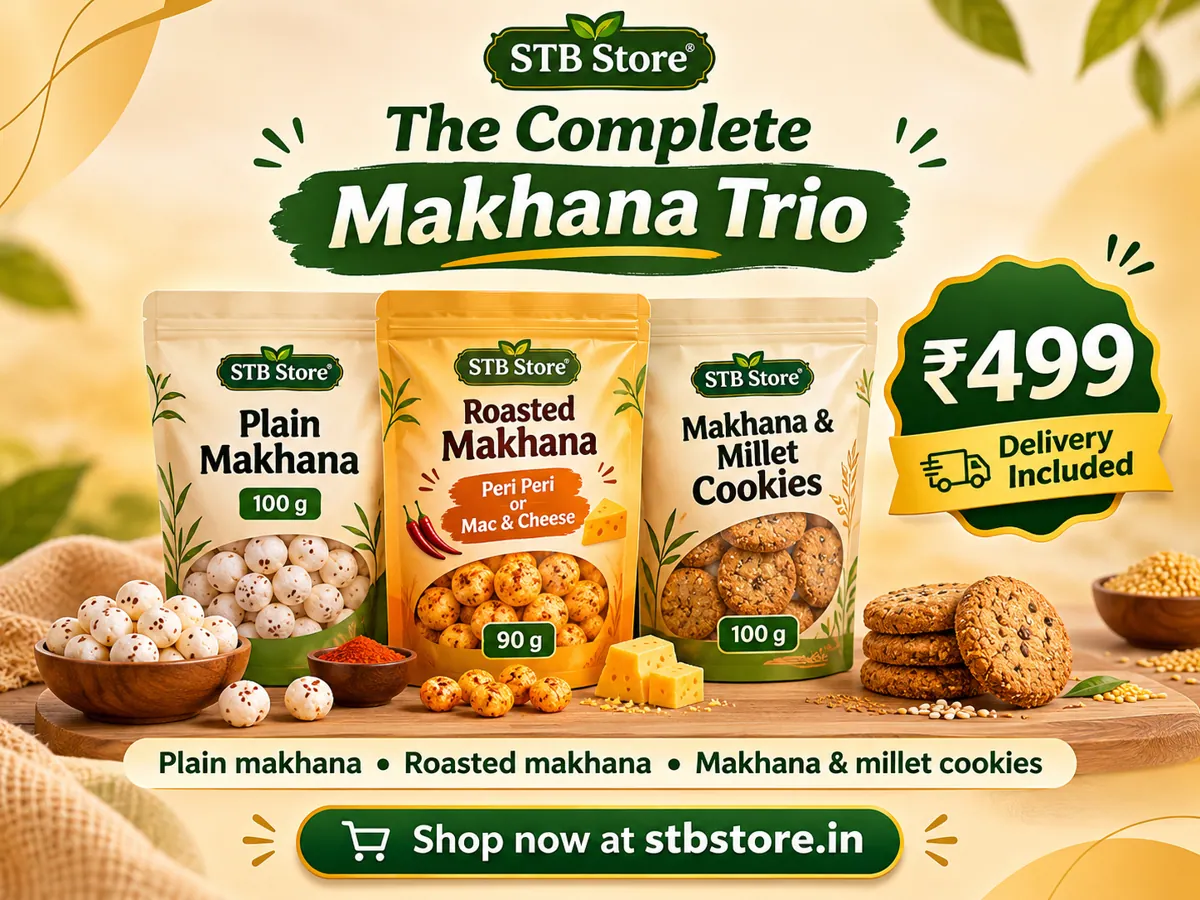
STB Store offers a combo that lets customers explore these different forms. It is a convenient introduction to makhana-based snacking, not a claim that all three products have the same ingredients or nutritional profile.
It is easy to focus only on the crunchy white puff. But behind it are water-based farming systems, skilled harvesting, processing work, research institutions and regional traditions. The GI registration for Mithila Makhana is one visible recognition of that connection between product and place.
So the next time you open a pack, remember that the journey may have begun in a pond, passed through careful sorting and heat processing, and ended as a simple snack. Appreciating that journey is one way to make a more informed purchase—and to recognise the people and knowledge behind an everyday food.
Is makhana a lotus seed? Makhana comes from Euryale ferox, not the sacred lotus (Nelumbo nucifera), although the terms are sometimes confused in everyday speech.
Is all makhana from Bihar? No. Bihar is a major production region, but makhana is also cultivated elsewhere. Check specific origin claims on individual products.
Does GI-tagged mean organic? No. Geographical indication and organic certification address different matters.
Can I buy the three STB Store products separately? The current STB Store offer is a preassembled trio combo rather than individual packs.
Editorial note: Product details and referral terms should be reconfirmed before publication. No specific farm or supplier origin is asserted for STB Store’s products.
Original-photo shot list
1. Wide pond or field cultivation shot from a credited Bihar photographer. 2. Close-up of raw hard makhana seeds with accurate identification. 3. Real popping or grading process, with location and permission. 4. STB Store’s actual three supplier packs together, labels readable. 5. Plain makhana, seasoned makhana and cookies plated separately. 6. Mobile screenshot of the live referral signup page (avoid displaying personal data).