The Makhana Journal · Article 6 · Buyer checklist
How to Select Good Quality Makhana: A Practical Buyer’s Checklist
Learn how to judge makhana freshness, crunch, colour, pack seals, ingredients and value before you buy online or in a shop.
The mistake most first-time buyers make
A packet with big white pieces and a premium-looking photograph is tempting. But good makhana is not a beauty contest. If you want a satisfying snack, you need to think about freshness, texture, ingredient information and packaging—not simply the size of the pieces. This guide turns a vague promise like 'best quality' into checks you can actually perform. The checks are especially useful when your first order arrives and you need to decide whether the product matches its listing.
Start with the type of product you need
Plain popped makhana, ready-seasoned roasted makhana and biscuits made using makhana flour are different products. A comparison is meaningful only when you know your intended use. For homemade kheer or a spice mix, plain popped makhana offers flexibility. A seasoned pack is convenient for immediate snacking. Cookies are a baked food with a broader ingredient list. Do not rank one above another solely because the word 'makhana' appears on each label.
Look through the packaging if you can
In a transparent or windowed pack, a reasonably even appearance can be reassuring, though natural differences occur. Look for unexplained wet patches, substantial broken dust or material that appears foreign to the product. Some dark spots may be part of normal processing; any unusual discoloration or visible mould warrants caution. On an opaque pack, rely more heavily on trusted product information, sealed condition and seller support. A photograph cannot substitute for a physical inspection after delivery.
Seal integrity is non-negotiable
Makhana's appeal depends heavily on crispness. A torn, poorly closed or visibly compromised package can allow humid air to change the texture. Inspect the outer delivery package and the actual food packet separately. If the food pack is punctured, damaged or leaking, take clear photographs before opening it and contact the seller. Do not assume that a discount makes a damaged food seal acceptable. A protected package is part of quality, not merely presentation.
Read the ingredient list line by line
Plain makhana should have a simple ingredient declaration. Seasoned versions may contain oils, salt, spices, flavourings and ingredients that trigger allergies. This is particularly important for cheese-style flavours or products made with milk, peanuts or wheat. A consumer with an allergy should read the actual manufacturer label rather than relying on a general description like 'healthy snack'. FSSAI's label-reading guidance emphasises ingredients, serving details and other mandatory information.
Dates and storage instructions matter
Check the date marking on the pack and the storage conditions that support it. Best-before, use-by and expiry language should not be treated as interchangeable. Some products prioritise quality retention, while other date statements have stronger safety implications. Follow the instructions printed on the actual pack and do not override them with an arbitrary internet shelf-life estimate. Avoid buying more than you can reasonably use if your storage space is humid or regularly exposed to heat.
How to assess texture after opening
If the seal and date are satisfactory, open the pack with clean, dry hands and taste a small piece. Plain popped makhana should normally feel light and crisp, not damp or oddly rubbery. Flavoured packs may have a different surface feel because of coatings, so compare them with the product you actually purchased. A stale aroma, unexpected off-flavour or signs of spoilage are reasons to stop eating rather than trying to mask the issue with stronger seasoning.
Compare cost per 100 grams
Big price stickers can be misleading when pack sizes differ. Divide the price by the net weight and multiply by 100 to compare like products. For example, a ₹120 pack of 50 g costs ₹240 per 100 g, while a ₹220 pack of 100 g costs ₹220 per 100 g. That arithmetic does not prove which tastes better, but it clarifies the value comparison. For a mixed combo, calculate the total net weight and remember you are comparing a bundle of different snack formats, not one homogeneous ingredient.
A quick checklist for online orders
Before checkout, confirm the exact product, pack weights, flavour choices, delivery eligibility, payment terms and support contact. On arrival, verify you received the promised items and inspect the labels and seals. Save the order details until you know everything is correct. If your retailer offers a combo, ask whether individual components are sold separately or only as a bundle. These small steps matter more than hype-filled labels and vague claims of purity.
The takeaway
Buy good makhana by matching the product to your recipe, reading its label, inspecting the seal and checking its texture after opening. The best pack is the one whose information is clear and whose condition matches your expectations. Buying intelligently is more reliable than choosing by package artwork alone.
An easy five-point scoring system
If you are comparing two packs, give each one a simple yes-or-no check for clear ingredients, readable date, intact packaging, stated net weight and usable seller contact information. This is not a formal laboratory grading system, but it encourages careful buying. It also prevents a large promotional discount from hiding missing information. A product with unclear ingredients may be inappropriate for an allergy-sensitive household even if it wins on price or pack design. Keep a screenshot of an online listing so you can compare the delivered pack with what was actually promised.
How to judge a new brand fairly
A new seller does not need hundreds of testimonials to communicate clearly. Useful signals include accurate product photographs, honest shipping restrictions, transparent customer support and an easy-to-find returns policy. Be cautious with websites that rely on dramatic health claims while hiding practical information. If a store offers multiple original supplier brands in one box, read the manufacturer details for each component. The seller of the combo and the manufacturer of a particular snack are not necessarily the same business, so the labels remain your best source for ingredient-specific questions.
What to photograph after delivery
For your own records, take a quick photograph of the sealed parcel, the front of each food pack and any date or allergen panel you expect to reference later. If you encounter damage or a missing item, these images make the issue easier to explain to support. You do not need to post complaints or sensitive order information publicly to ask for help. When sharing positive snack photos, make sure brand and pack details remain accurate. A close-up of a bowl is attractive, but it cannot replace a picture of the labelled item a shopper will actually receive.
Reader questions
Does bigger makhana always mean better quality?
Not necessarily. Size can be a grading characteristic, but freshness, clean packaging and correct ingredients also matter.
How should I compare differently sized packs?
Use the price per 100 g and compare only similar products.
Explore more at STB Store
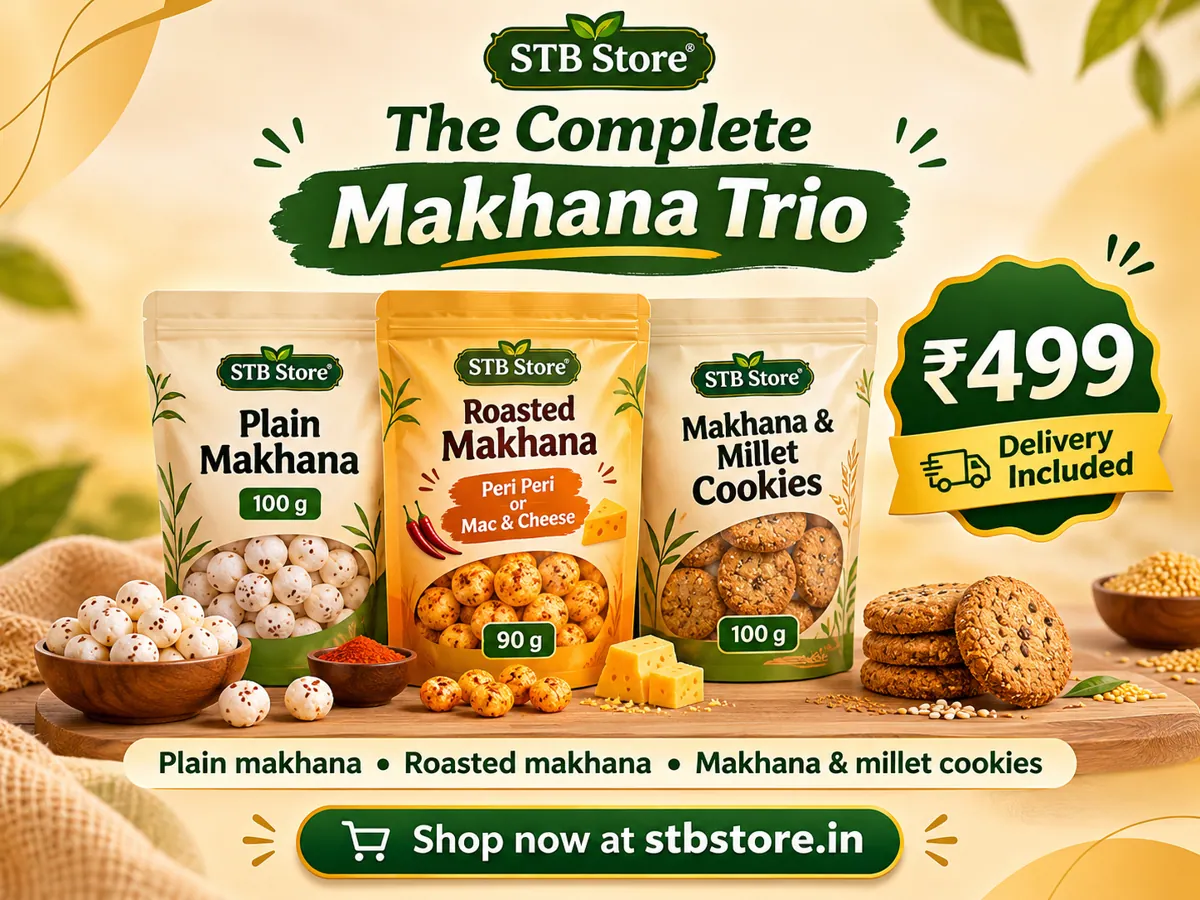
Learning about makhana is easier when you can compare an everyday plain ingredient with ready-seasoned and baked formats. The STB Store Makhana Trio offers plain 100 g, a choice of roasted 90 g (Peri Peri or Mac & Cheese), and makhana & millet cookies 100 g. The bundle is ₹499 with delivery included where the PIN code is serviceable. Always check the latest original pack labels, ingredient lists and delivery eligibility before ordering.